
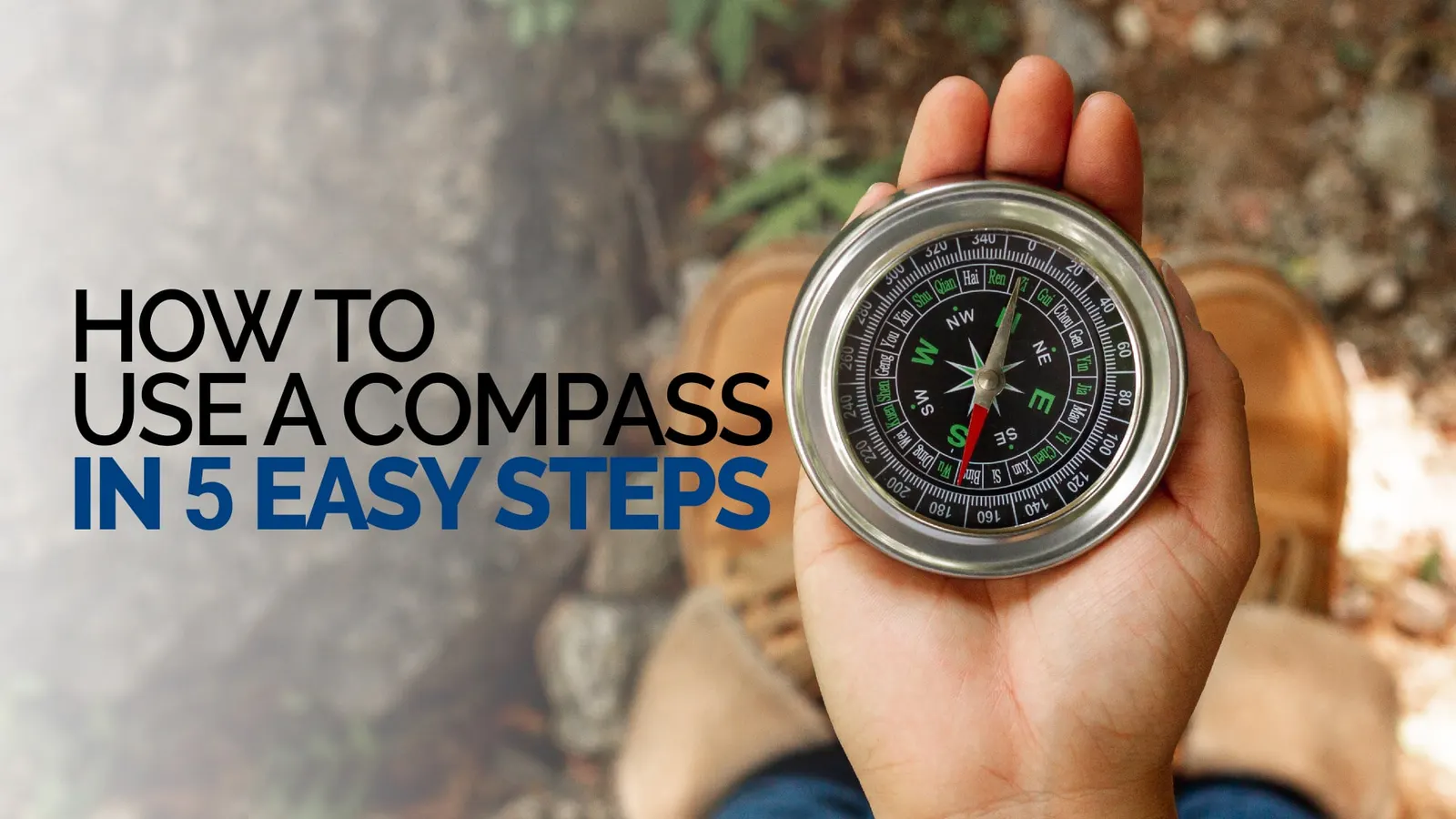
If you want to explore some of the wonderful countryside that we are truly fortunate to have in the UK, then being able to find your way around is an essential skill. That means that you should carry a compass and a map with you when you are out. While many modern phones have good software on them that can help you find out exactly where you are, it can sometimes be difficult to get a signal. Worse still, if you run out of battery you could find yourself stranded in the middle of nowhere without means to get yourself to safety.
Learning to use a compass is one of those essential skills that people think of as daunting; but it is really quite simple to get to grips with. Read on as we look at the essential steps you need in order to use a compass.
Step 1
Before we begin let take a very brief look at what a compass actually is. A compass is an instrument which shows you north, south, east, and west, the cardinal points. The addition of a magnetised free turning needle you have a magnetic compass.
Features on your compass that you might need to know include:
- Orientating lines – these will help you line the compass up on your map
- Baseplate – The plastic the compass is mounted on
- Magnetic needle – A “floating” needle that points towards magnetic north
- Magnifier – the small area of the base plate that helps you read smaller details on your map
- Direction of travel arrow – once your compass is set, this is the direction you follow
- Index pointer – an extension of the direction of travel arrow. When you rotate the compass housing, it marks the bearing you set
- Compass housing / bezel – this rotates to help you take bearings. Sometimes called the Azimuth angle, it marks the compass heading / direction
- Declination marks – the magnetic needle points towards magnetic north. If you want a north reading that is true, you need to alter this for magnetic variations
Step 2
A compass may seem like a simple bit of plastic but you shouldn’t underestimate it. Take care of your compass around any items made of metal as it may affect your readings. A compass will not only react to the earth’s magnetic field but also to metal objects as well.
Step 3
Once you know what you are doing taking a bearing is a relatively easy process. Before you begin you will need to know two particularly important things. The first is where you are, and the second is where you are going.
Place your compass on your map and make sure that you line up the edge of your base plate so that it touches both your start and finish point. Do not forget the direction of travel arrow needs to point in the direction that you will be travelling.
Step 4
Holding the base plate in position, you should rotate the housing of the compass until the orientating arrow is lined up with north on your map. The lines that you can see inside the housing should run parallel with the map’s gridlines. Check that the direction of travel arrow is still pointing to the north on the map. To find your grid bearing all you need to do is read the bearing that is on the rim of the housing.
Step 5
Pick up the compass from the map and hold it out in front of you. The directional arrow should point ahead. Turn your body so that the compass needle moved over the top of the north orientating arrow (this is the red one). The direction you need to go will be indicated by the directional arrow.
When you know which direction you should be travelling in, take a good look into the distance and see if there is a landmark you can head towards – and make sure that it is isn’t too small. Once you arrive at the landmark you should check your compass and repeat the entire process. Along with your compass, you may want to invest in a map case which will keep your map protected against the elements whilst you are out. This will help to make it easy to read if it is rainy.
If you’re planning on using a compass on your next camping trip, it might be worth getting used to using it at home before you travel to new places. Then you can be sure you can get your bearings when you need them.