Are you an environmentalist or a nature lover?
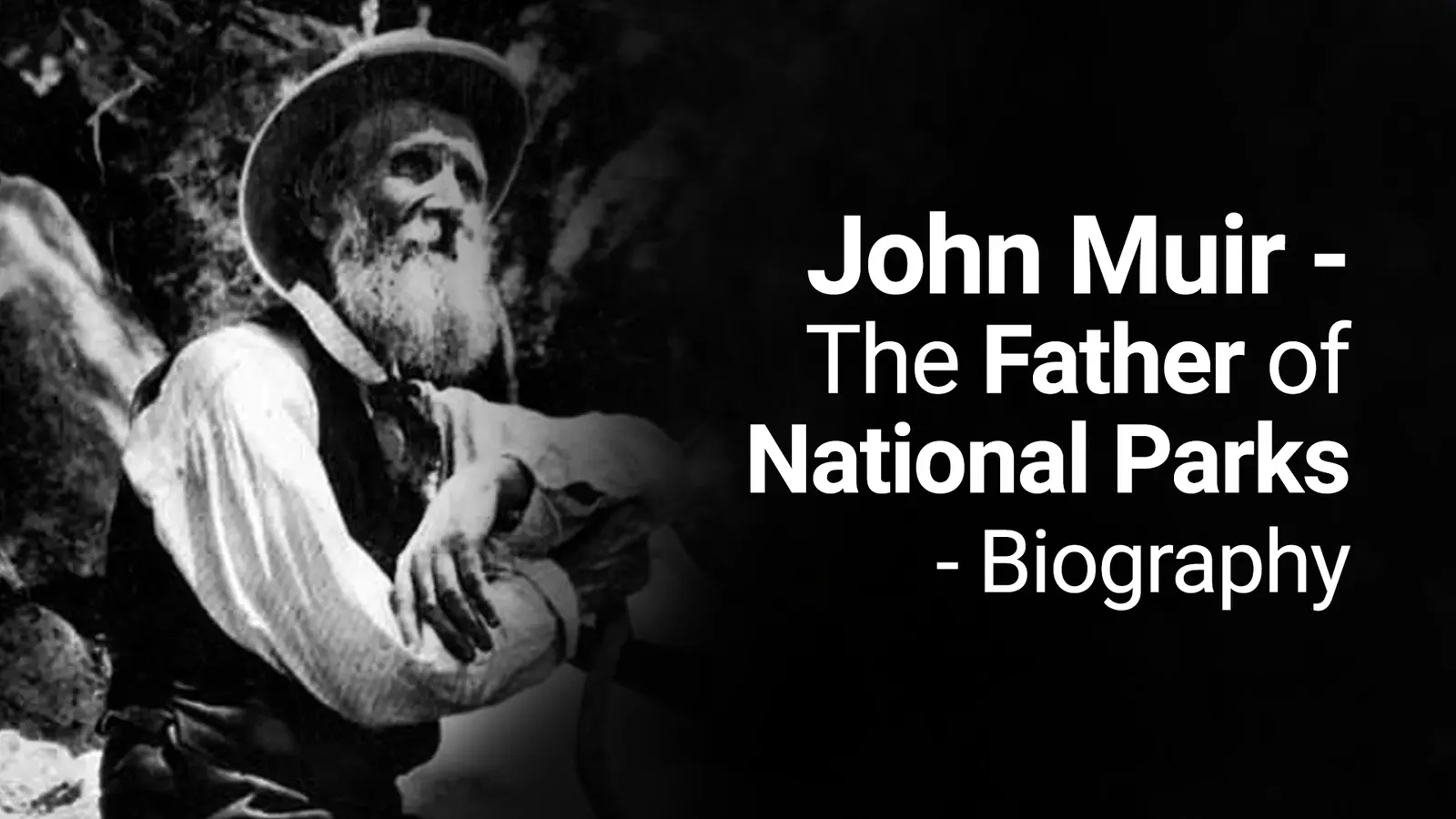
If so, chances are that you would have come across the name John Muir in passing some way or another before—whether in a casual conversation or in an article.
So who exactly is this John Muir? If you are still unsure why this name keeps popping up, then it is time to learn more.
Do not feel ashamed if you do not know anything about him other than his name.
The fact you have read till this far says a lot about your willingness and appetite to learn more, and that itself is a very admirable thing to do.
Although it might be a bit uncouth to some to make this comparison, John Muir can be considered as the Greta Thunberg of the past, specifically when it comes to the sphere of National Parks.
A wordsmith and an environmental activist whose influence reached president Theodore Roosevelt, culminating in the establishment of the first national monuments by presidential proclamation.
Sounds amazing?
His contributions do not just end here, he also by extension, lead to the creation of the beloved Yosemite National Park in 1980.
For the literature lovers, he wrote many essays and books, such as the prolific The Mountains of California and My First Summer in the Sierra.
These are just some of his more notable achievements, and in fact, his contributions cannot be summarised in just several sentences.
You might have even heard of him while doing research for places to go on a road trip.
Let’s take a deeper dive.
John Muir’s Early Years
Born in 1838, John Muir was the third child of eight of a mildly stringent household.
When he turned 11, his family purchased a plot of farmland near Portage, Wisconsin.
As one of the older children, his father made him help out on the farm work, which took away most of his time for reading and studying.
This was further compounded by the fact that his family was rather pious, and necessitated John to memorise Bible verses.
Thankfully, John managed to convince his father to be wake up earlier so that he could have some to read and study topics that interested him before heading to complete the duties of the farmland.
Even at this age, he exhibited signs of genius, introducing several inventions such as a horse feeder, a wooden thermometer, and other eccentricities in the 1860 Wiscon State Fair.
In 1861, he attended the University of Wisconsin, performing well in academics.
After three years of studying, he had an epiphany and realised that nature was his true calling.
So he left the university to pursue studying botany and the natural world while juggling odd gigs on the side to fund his travels and work.
In 1867, John met with an unfortunate eye injury while working in a factory.
It was rather serious, causing him to be blind for an extended period of time.
This event actually reaffirmed his passion and love for nature.
Once he recovered, he decided he wanted to spend his life to for fight for nature, and also to experience all sights Mother Nature has to offer.
And so he did—he travelled to Indiana, Florida, Cuba, New York, Panama, and San Francisco, detailing all the scenic sights he saw in his travels with sketches and writeups.
Little did he know, these sketches and writeups will then become legendary works that inspired people to appreciate the beauty the natural world has to offer.
Yosemite Valley
In his travels, while on-route to California, he visited Yosemite Valley while working as a shepherd.
His work as a shepherd made him realise how modern society may endanger the natural ecosystem unknowingly—specifically, how domestic livestock could have destroyed the beauty of Yosemite Valley.
Following this, he began to fervently write articles in support of the preservation of the valley.
By the early 1870s, his article began to gain traction amongst other academics, paving way for theories that were not even being thought of at that point in time.
John had a keen eye for detail and he was able to convey them in his writings and essays, bringing much attention to Yosemite Valley and its geographical makeup.
It would not be an exaggeration to say that John Muir’s essay led to the establishment of Yosemite National Park in 1890.
The essays also went on to
necessitate the creation of parks in the Grand Canyon and the Sequoia region.
In 1903, John Muir and the former president Theodore Roosevelt went on a three-night camping trip.
This trip would then later shape the way the president’s thoughts and perceptions towards nature, and in turn, result in policies that were put in place in favour of the preservation of nature.
One of such is the Yosemite Recession Bill in 1906, which put Mariposa Grove of Giant Sequoias under federal protection and by extension, part of Yosemite National Park.
A total of five national parks, fifty-five national bird sanctuaries and wildlife refuges, 150 national forests were signed into existence throughout Theodore Roosevelt’s presidency, indicative of how John’s passion for nature rubbing off on the former president.
As such, we can really see how John Muir played a crucial role in all the beautiful natural landmarks we get to enjoy today.
Later Years and Legacy
In 1892, John Muir started the Sierra Club, which is also the largest and most influential grassroots environmental organisation in the United States, with over three million members and counting.
Today, this organisation actively engages itself in protecting the wilderness and shaping the conservation ethic.
While accumulating countless awards and accolades for his admirable work and passion pertaining to nature, John Muir passed away in 1914 due to pneumonia.
In an era without social media and the internet, this man alone managed to spark and infect people’s interest and love in the natural world that could have never manifested without him and his indomitable passion for the natural wonders.
Even though John Muir is no longer here with us physically, his works continue to inspire and educate many environmentalists today.
He is indeed the Father of National Parks, as dubbed lovingly by his supporters.
As we reach the end of this article, we leave you with one of his iconic quotes which encapsulate his beliefs beautifully, “Thousands of tired, nerve-shaken, over-civilised people are beginning to find out that going to the mountains is going home; that wildness is a necessity”.